See also:
What’s the Matter with Guide Dogs Chapter 1: What Happened at the Airport?
What’s the Matter with Guide Dogs? Chapter 2: Marra and Jats-The Gold Standard
What’s the Matter with Guide Dogs? Chapter 3: The Strange Story of Barley
What’s the Matter with Guide Dogs? Chapter 4: Old School and New School Diverge with Marra and Sully
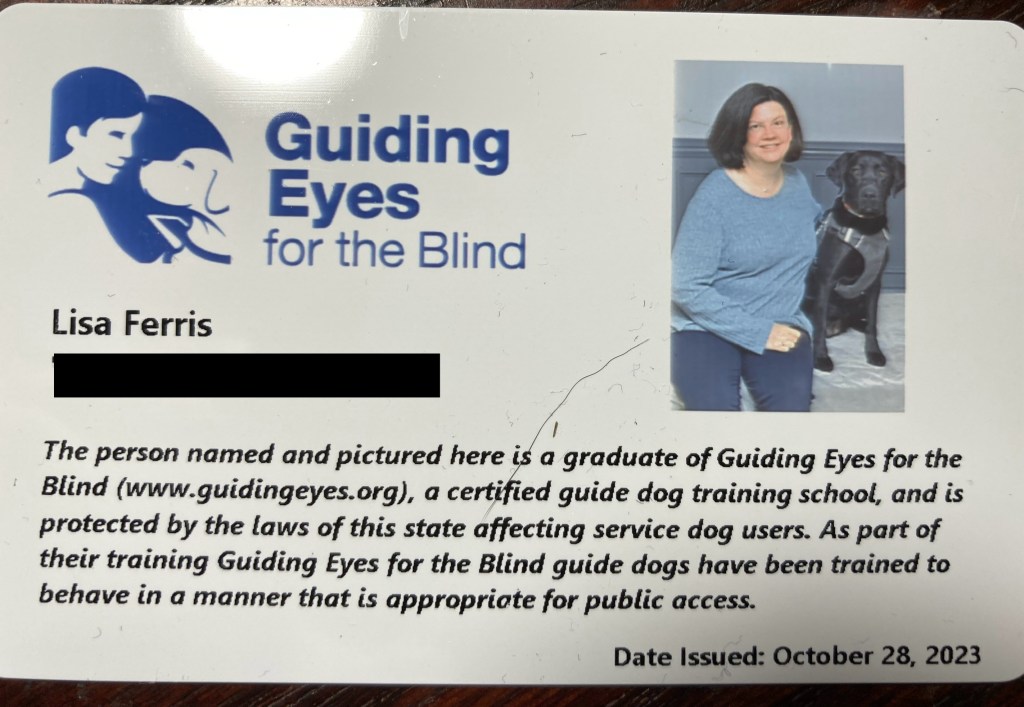
It’s really too early to write this chapter, but I also have the advantage of memories of training very fresh in my mind. I had to take a bit of a break because I was really devastated by the sudden and unexpected death of Marra a few weeks ago. She died in her sleep of what the vet thinks was hemangiosarcoma, a spleen tumor that suddenly ruptures and caused internal bleeding. It was a real blow to me and our family. She was happy and well up to that night and we expected her to be around for at least a couple more years with us. She was happy to play with the new dogs, Cobey and Mia that we had just gotten in October from Guiding Eyes for the Blind.
So it’s a little hard to write about guide dogs still, because of grieving Marra but also because this training was by far the toughest and most confusing I had ever experienced. And it’s a little unfair to the new dogs as I don’t think we’ve seen their full potential yet. I also want to stress that I am going to explain to the best of my memory what my training experience was like at Guiding Eyes as honestly as I can, but I do not understand the why’s of what occurred. I can only speculate. I also had interactions mainly with one trainer, and I don’t want to villianize any one particular person. As I’ve said before, I think the problems with guide dogs as of late are systemic, not limited to one trainer or school. But since I am just a student, it manifests itself to me mainly through one trainer, so that is what I will largely write about. But I don’t think it’s necessarily that she herself is at fault. And I have no desire to get her or anyone else in trouble. I more want to open a discussion and open transparency and sort of a self-awareness among the industry that seems lacking right now.
I also want to say that I love Mia, like a lot. I love my partner’s dog, too. I have seen so much growth and change in Mia since I brought her home and worked with her for the last 6 or so weeks. She is a fast learner who likes to go out and guide. She has lots of potential and I remain hopeful.
Why we chose Guiding Eyes
This is a bit of a sordid tale that looking back, seems maybe a little misguided. But I’ll tell you how it came about. It started in 2018, when my husband retired Sully. It seemed at the time, and based on my experiences with watching the other trainers in 2014 at GDF, that after the mass firing at GDB, their trainers had taken over the world. Their low expectations seemed to have permeated GDF, even though I lucked out and got my old school trainer, Mike. We had heard that the only place you could still get a well trained dog was at the one and only original school, The Seeing Eye (TSE) in Morristown New Jersey. So Nik applied there. The downside of TSE is that they still require you to go to 26 days of training, have no home training, and also give almost no notice to when you will go to class. As our small business was only four years old, this was a real issue for us in 2018 more than it is today, when we have additional support staff and trainers to cover for us that we didn’t have then. So, we thought we would work it out, but it kept being put off and put off by TSE. After a year, Nik started reading about GEB. He liked that they were working with new types of harnesses and had a running guides program. He liked that they did 2 week training, home training and tha the CEO was blind. I liked that they had special programs for Deafblind folks and people with additional disabilities. TSE still says that Deafblind people aren’t qualified to have a guide dog on their website, even though I know of at least one person who is deaf blind that graduated from there. So, Nik applied to GEB in 2019.
Then the pandemic happened. All operations stopped at all the schools, and then were greatly curtailed for nearly 3 years. Then there was a backlog of applicants. Then, Sully died. When he died, Marra was almost 10 years old. I thought she might have another year left to guide. It was so hard watching Sully grow old and die, and then Nik would have a young dog and I would have an old dog and we’d go through it all again. I also was on the kidney transplant list, and it would be better for me to get a dog sooner rather than later, since my future was so unpredictable. So we thought, what if I apply now, and Nik can wait a couple more months for my application to go through and then we would go at about the same time, so that our dogs were in the same stage of life? Wouldn’t that be easier than having a slow older dog and an energetic young dog all the time and being out of sync always?
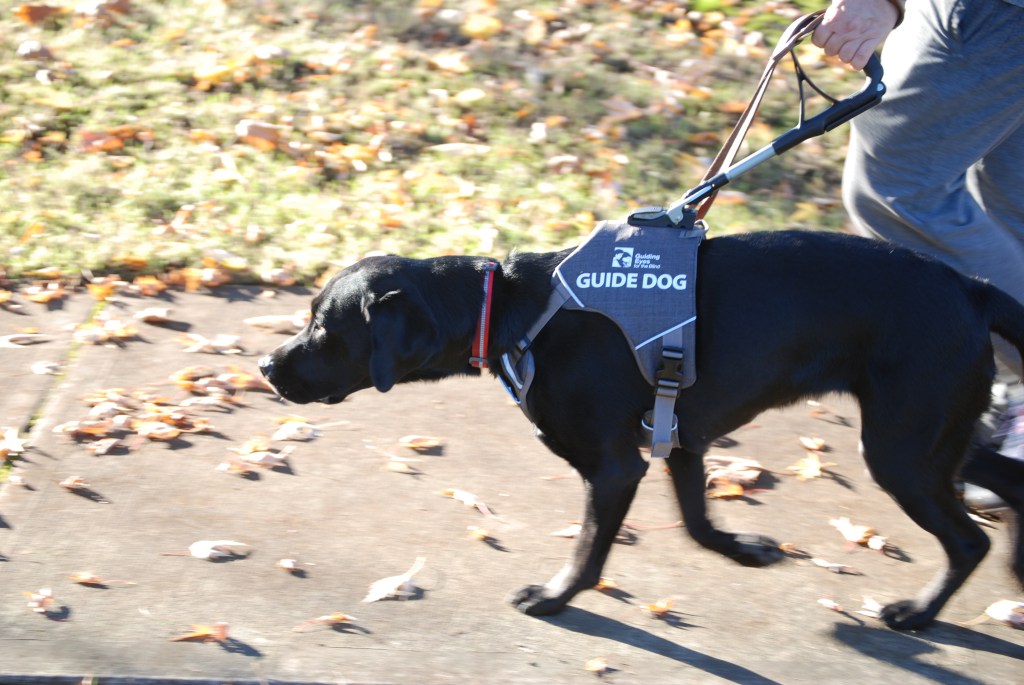
So I emailed GDF and GEB and explained my situation. GDF never got back to me. GEB got back to me promptly. So, I just applied there. At first they seemed amenable to my plan of Nik waits a little bit longer and I wait a little bit shorter and we both get dogs about the same time. But in the end. I waited about a year, which is the average amount of time, and he waited that same year with me. Weirdly, his dog’s trainer said he picked Nik out for Cobey in around the end of August, but he didn’t go get him until October. We also asked for home training, and a trainer was advocating that she could come out in the fall and train us both, but that didn’t go through. So poor Nik waited 5 years for a new dog after Sully. Of course some of that could not be helped with the pandemic, but we ended up going to training in the same class.
The Training
I went in to training just thinking that as a person who has gone to different schools, things would of course be a little different. I just thought I would do whatever they said for the two weeks, keep what made sense and revise the rest when I got home. Of course, I knew I would make mistakes, though. When you have said “halt” to a dog for 30 years and now you have to start saying “wait,” you know you will screw that up sometimes. When you’ve wrapped the leash around your wrist for 30 years and now they want you to use it in the right hand or tuck it under your left fingers, you know you will instinctively do it how you’ve always done it at least part of the time. My job with these trainers in this two weeks was to learn what the dog knows so I have the “key” to unlock their training they already know. This is exactly the discussion that my trainer Kat and I had. I told her that I would hold the leash like this (around my wrist) but I could do it the other way, too. But I’d probably forget sometimes. She was totally on board with this, and seemed open to seeing how I had done it before and telling me what the new dog would be used to. Perfect!
GEB lets you ‘try out’ a couple of dogs before you get your match the next day. It’s a little weird, but also kind of cool. The first dog I tried (and you don’t get to know their names) wiggled and squirmed all the way down the street. I mean, it’s a bit unfair to the dog. They don’t know you. But you have about 15 minutes to judge. The second dog I tried turned out to be Mia. When I held the harness, she was steady. it felt like a guide dog when the first dog felt like my pet miniature dachshunds of my childhood. When I brought Mia back to my room. She sat there, on the floor and barely moved. it was weird. All of my other past guides were thrilled and excited to meet me. She just sat there. Wow, this dog is super calm! I thought. She was also very small at only 53 pounds. That appealed to me because the airlines are putting restrictions on service dog weights and I’d been lying about Marra’s weight for the last few years because of it ( the cut off for some airlines is 65 pounds. Marra weighed about 70-75 pounds her entire life.) With this little dog, I could stop lying on the forms. I chose her.
I did not get her until the next day, and we were allowed to hang out with the dogs for an hour or so in our rooms before we did any training. This is when I saw the problem. She wasn’t calm and mature. She was scared. I hadn’t noticed the day before, but she was sitting so calmly not next to me, but next to a kennel in the room. I opened the door to the kennel and she immediately went inside. And she didn’t come out. Ever. unless food was involved. All dogs are different, of course, but this dog was damaged. Like a foster child who had been taken away from so many people that they were burnt out of building relationships anymore. I coaxed her out with treats and she would go outside with me or she would let me pet her for maybe 30 seconds or a minute. But then she would go back inside her kennel, and curl up in the back as far as she possibly could. That was our life for the first two weeks. If I shut the kennel door, she would crawl under my bed to where I couldn’t even reach her.

Meanwhile next door, Cobey and Nik are having a love fest. Cobey was like the foster child that was in constant need of attention. He sat on Nik and gave him full body hugs with his paws around Nik’s neck. And if Nik went to the bathroom or left for a second, he immediately came to me and was stuck to me. Cobey was the one who could get Mia out of her kennel. She was very dog oriented and very interested in him. We let them play together from about the second day. and it was pretty violent. I mean, not that you worried that anyone was going to get hurt, but Mia would just not let Cobey hang out. She was constantly at him, pawing chasing and barking at him. I heard Mia bark more in the first three days than I ever heard any other of our guides bark in their whole life–combined. Now I know dogs do this, especially at first when they are getting to know each other, but Mia would not let up. It was constant when they were out together. So you had Mia in the kennel or under the bed, and Mia fighting with Cobey. That was what she did. And in between, we tried to get some training in.
Guiding Eyes has really no on campus facilities to train in. The first couple of days we trained on sidewalk less streets right around the campus. Streets with no sidewalk are necessary to deal with in life, but it’s not necessarily the best place to start out with a guide dog. My first real training with Mia was weird. Determined to learn everything about what this dog knew, I was surprised to find out that Kat didn’t know what this dog knew really. I would instinctively say commands in given situation and then stop myself and ask Kat, oh! Does she even know this command? Is it something different? And Kat would often be vague or say she didn’t know. At first, she said she didn’t know because I picked the dog she didn’t expect me to pick. But I thought she could easily find out in the next couple of days, but it seemed as if she was never really clear on what the dog knew or didn’t know. I would say, “Straight!” and she would say, “I don’t think the trainers use straight anymore.” Okay, so what do they use to redirect the dog or get them back on task? Does she know “leave it?” “Well, that is a command she may have heard. I don’t know.” she would say.
What? isn’t there consistency among trainers? There was a sort of glossary of commands that was given to us. Much of it was the same things I already knew. But it was extremely short. There weren’t that many commands. I’m used to my dogs knowing upwards of 40-60 commands and the glossary included maybe 10-12 or so? But I think Kat and I had a fundamental difference of opinion about something.
Kat said early on that she has determined that dogs don’t know English. They just base everything on your body language and routine. This is why they also teach hand signals.
I think this is 100% wrong. In all my dealings with guide dogs and pet dogs, I think that is wrong. It’s just wrong. And for blind folks, I think it also can be kind of a dangerous way to think.
Now, I get that dogs may not comprehend words in the way that we do, with the same sharpness of clarity for phonemes etc. I get why a dog might confuse the command chair and stair for example. So maybe you change one word to seat or the other word to step. I also have always been taught hand signals with dogs and know they can respond to these with out words. I even taught Mara some signs. I get that hand signals and body language help reinforce the behaviors you want them to perform. I’m not anthropomorphizing dogs, here. I get that they are different from humans with different strengths and motivations and perceive the world in a way I or no human can completely understand.
But they can understand enough speech to be guided by speech. And speech for blind people with guide dogs is important. Probably more important than just sighted pet owners. Many blind people are very auditory focused and much less proprioceptive. All blind people are different, but a lot of blind folks do better by using speech instead of hand signals and body language because our body language can be…well… a little different.
For example, one thing I am watching Nik and Cobey work out is that Cobey pays attention to Nik’s body language way more than his words, and sometimes Nik’s body language is not portraying a clear signal to Cobey, or not the signal that Nik means to convey. I have seen Nik and Cobey go up to curbs and then Nik will say “Left” which for our former dogs would constitute a 90 degree turn to the left and a realignment with traffic at that angle. If an intersection is not exactly 90 degrees, which many aren’t, the dog will still line himself up with the line that will cross the street straight from the traffic. If Nik turns left but only 45 degrees or not right in line with the cross walk on a weird street, our old guide dogs would lead him to the correct line of traffic. The command “left” is complex and means something to the dog that is separate from exactly where Nik’s body is facing. Nik turning to the left might be a back up clue that reinforces the command, but it isn’t THE COMMAND. But Cobey is looking at Nik’s body, more than he is listening or processing the command “left.” If Nik turns 45 degrees to the left, so does Cobey. If Nik would then say “forward,” Cobey takes Nik right out at 45 degrees, rather than aligning to the correct line of pedestrian travel in the intersection. I’m sure when the sighted trainers use a hand signal and their bodies to indicate “left,” they are doing so in a perfectly orderly left fashion. and the dog complies to that. Then the dog goes to a blind person and their hand signal and body are only sorta kinda left. And the dog follows. This is why training the dog solely on body and hand language is ill conceived for the blind population. Of course, some blind people are not going to have a problem with this, but more than a small amount are. And sometimes you have things in your hands and can’t do a hand signal or you unconsciously turn your body a way you didn’t mean. Verbal commands are clear and concise and intentional. And dogs can totally understand what “left” verbally means. This is an example of trainers not seeming to understand what blind people deal with in real life and only train the dog under very controlled conditions that are not realistic in the real world.

There was also an issue with the dogs not guiding on leash. Our GDF dogs always guided on leash. This is not something that you would do for a long outdoor walk. Guiding on leash is for just taking your dog out to pee or just a quick walk down a hallway in a strange building. Nik and I struggled with the fact that the dogs don’t guide on leash. We actually knew this going in, so we are somewhat responsible for this ourselves. But when we say these dogs don’t guide, they REALLY don’t guide. In my past trainings, the first day was just going around the building on leash with the dog guiding you. You would use all the same commands as when they were in harness. You hold the leash with almost no slack, and they guide you. It’s not as comfortable for the dog and not as clear to follow the dog with just leash, but for short distances, it works well.
But the first couple of days getting around were a struggle. Its not that we didn’t know the lay of the land in the building, but its stuff like, there would be a janitors bucket out, or another dog down the hall and your dog is pulling with all their might dragging you out of your orientation as to where you are or they are busy sniffing the floor somewhere or dragging you into an interesting room. We were supposed to “heal” the dogs in these situations. In GDF parlance, “heal” is a position. The dog goes to your left side, faces forward, and waits for a command. At GEB, “heal” was more like how obedience classes at Pet Smart teach people to heal their pets. The dog should walk along side you but not guide you. Kat said they work hard to get the dogs to heal, but why? When does a blind person ever need their dog to heal, really? If you are sighted, you can walk forward with confidence and the dog can follow you. If you are blind, you are not going to walk in confidence if a dog doesn’t guide and you don’t have a cane. I was under the impression that we were not supposed to use our canes with the dogs healing as I had never been taught this before. It was unnecessary if the dog guides on leash. Even Barley guided on leash, even though I don’t think the was specifically taught that. Sure, sometimes you would go sighted guide or use a cane while holding your dog’s leash, but they would just adjust. So, I started feeling unsafe walking around the building with Mia “healing” because she was a nut. I asked Kat about it and she said, “That is why I told you that you can use your cane.” She absolutely did not tell me that. She did not tell Nik that. It felt like a gaslight. I ended up consoling myself by thinking, “well, she didn’t tell me NOT to use my cane. And maybe she really did think she told us that. She has classes every month.” But it was confusing. When I started using my cane indoors while walking Mia in heal position, it helped a bit, but it was still hard.
One thing that was hard is that when she would be goofy in “heal,” I would use commands, the only ones I knew, to redirect her. But I was told these were “harness” commands and I couldn’t use them when she was not in harness. Wait, wait, wait..so they don’t know English, yet they have a whole set of separate languages in harness and out of harness? Ooookaaaaay. But then, I said, what are the redirect words? We don’t know if she knows “leave it” so that can’t be it? I tried using “hupup” (which was previously to me a word used to speed a dog up, but here it seems to be a redirect word in harness only.) I can’t use that when she isn’t in harness. So literally, I’m standing here in the hallway and my dog is pulling my arm off, scrounging the ground right now. What should I do?”
“Use a leash correction.”
Really? Really? That’s it? That’s all you’ve got? I’m going around wearing a food pouch because you all have convinced me this is the humane, positive way to control a dog because leash corrections are so old fashioned and cruel, but there are no commands to redirect a squirmy dog except a leash correction? I’m so confused by this.
I did not understand Kat. Maybe it was different communication styles, maybe it was just that we didn’t quite jive. I did not dislike her. I feel like in a different situation, we could have gone out for coffee and had a great conversation. I just did not understand anything she said because she either seemed to not know or answer my questions in ways that were not definitive. Does this dog know ____? It seems like a yes/no question. Or at worst, an I don’t know question. But the answers I often got were, “maybe in some circumstances she knows this or maybe has heard it but she may not have been trained with it or that is not what this trainer does or you can use that if that is comfortable for you or what would you do?” I never knew what I was supposed to be doing with this dog. It seemed like I was training the dog from scratch because often, Kat would give me nothing in a given situation so I would just revert back to what I knew with past dogs. No wonder my dog was scared and hid in the kennel all the time.
Occasionally, I would work with other trainers, and I would see part of the problem. None of them used the same methods or commands. I was in grand central station and another trainer was literally feeding me the commands to tell me dog because it was so busy and loud. She said, “give her a ‘right right’ here.” I’d never heard that term, what does it mean? So there is right, over right, to the right, and right right. For my past dogs, right was a sharp immediate right turn. Over right was a gradual drift to the right. Find right would be to find the next opportunity where we can safely turn right. Right, right? That was a new one to me. Which is to be used where? What does this dog actually KNOW? No one really could tell me. She asked me to get out my clicker. I was never given a clicker. I heard them on campus sometimes, so I know that some trainers seemed to use them, but my dog did not seem to respond to them. I mean, if one trainer stayed with the same dog all the way through, letting the trainers use different commands might have been ok. But in this case, Mia seemed to have had 4 or so trainers. (More on that later.)
Nik and I were both shocked at what the dogs did not know. It felt a lot like when I was at GDB with Barley, and the dogs were so young and only had about 40 hours of training and only knew the basics. Mia’s basic obedience was pretty good, most especially when food was involved. She was not into me. She could care less about me. She would work for food. But there were big gaps in her knowledge and behavior that I hadn’t seen since I went to GDB with Barley. The dogs were not taught things like to distinguish between a curb (or single step) and a flight of steps. With our old dogs, on a curb the dog would stop and you would say forward and the dog would step off and you would follow. If it was a flight of stairs, the dog would stop, you would say forward and the dog would not go. Then you would put one foot down indicating that you understood it was a flight of stairs, then say forward again and the dog would go. These dogs were not taught that. The trainers didn’t seem to understand why this was important. We were just supposed to never be in a situation where we wouldn’t know the difference. Sure you can use context cues here. But have they never gone to say, a botanical gardens with a lot of irregularly placed steps? Have they never been in a building where all the sudden there are 4 steps in the middle of a hallway? These situations really happen. And your dog needs some way to communicate with you about that. They acted like they never thought of that before.

The dogs also had very little targeting knowledge. Targeting is one of the most useful tools guide dogs do. Some of it has to be taught after you go home because your environment is going to be different than where they came from. But some of it can be taught and generalized. The dogs could target doors. That’s it. That’s helpful, but not really enough to be useful. Marra could target elevators (the buttons themselves), garbage cans, chairs to sit in, counters, doors, upstairs, downstairs, ramps…am I forgetting anything? When I got home, I quickly taught her a few more things like bus stops, specific seats on the train, toll card readers, etc. Mia came home knowing almost none of this. And again, like at GDB, they were certain that these dogs could be taught specific targets, but not to generalize, and needed several step backchaining to learn a target.
And…this is a big one… they don’t seem to know intelligent disobedience.
They will say they do, because it is so fundamental to guide dog lore. But I have seen no evidence of it. Remember when Doug used to have us tell the dogs forward at an intersection when cars were coming right in front of us and they didn’t go? Yeah, no. these dogs fail at that. Now, they did do traffic checks successfully. This is when the trainers drive their cars right in front of you while you cross the street and the dog stops suddenly, avoiding the car. The dogs can do that. But when I asked a trainer how they teach intelligent disobedience, she really didn’t have an answer. She talked about how they would get a piece of plywood and push it at the dog so it would back up. Ok, so they can back up and stop when something is coming right at them. That is not the same as intelligent disobedience, which is when the handler gives a direct command and the dog refuses to follow it because it is too dangerous. One of the issues I had and still have with Mia is that she stops at curbs but then immediately pulls to go, even when there is traffic coming right at her. I have to physically hold her back. And then here is a Cobey story that demostrates a few of the issues we struggled with there.
Similar to other schools, GEB has the trainers right by your side, giving you the blow by blow visual information up ahead before you can even see how the dog will respond to it. Nik was really put off by this. So was I, but I had been called into the principal’s office two or three times by that point and so I had just given up on anything being productive coming out of this training. I was trying to lay low and bide my time until I got out and could start really working with Mia. On the last day, we had an afternoon where we could choose what we wanted to work on. Nik came to me and wanted us to ask to just go to a coffee shop on our own, and just see if we could do the whole thing by ourselves. He really needed to do that for his own confidence, because you can’t tell anything when the trainers are on top of you like that. You can’t tell what you are doing and what the dog is doing or if every obstacle and problem is just being secretly snowplowed away from in front of you. So I agreed, and we went to one of the GEB lounge areas where a coffee shop was just about 2 blocks away.
We asked simply for good blind people directions. We knew the trainers were going to follow us, but we thought they would stay at least half a block back. These were not our usual trainers, but there were two of them, and they seemed surprised at what we were asking. They definitely did not see the importance of it to us. They kind of had this attitude like “Okay, we will humor you.” We asked for directions and the directions they ended up giving us were very sighted people directions. Sighted people give directions as if they are driving somewhere and they can just see the signs and turn in somewhere. Blind people directions are much more detailed and based on tactile and other cues. Here is what they said about this coffee shop:
“Go left at the sidewalk and go to the intersection. Cross it both ways. Walk about half a block down and there is a Starbucks.”
“What can you tell us about the Starbucks? is it a separate building? is there a line of storefronts, is it a drive thru? Does the door face the street?:
“Um, yes, there is a line of buildings, but there is a driveway or two before you get there.”
Ok, so I interpret this like, we cross the intersection and then there are a bunch of storefronts close up to the sidewalk. Maybe there is a driveway or two interrupting the row of storefronts. The door faces the street and is not too far away from the street because it is a line of storefronts. So, we go until we smell the coffee, then find the door. We may pass a driveway or two on the way, but they are inconsequential.
We cross both streets no problem. We walk along and there are no storefronts! It’s like open and vacant. They are not half a block back, they are right behind us. They say nothing, we say nothing. I walk along and I smell coffee. I keep walking and the coffee smell goes away. I turn around. I tell Nik I smelled coffee but now it’s dissipating. Nik goes back and goes down a driveway. He comes back and says it is just a parking lot. We look it up on blind square while these people are RIGHT THERE staring at us creepily. He can’t find it on blind square. I walk a bit and listen. I hear people talking casually, like they are at tables. I hear someone walk by and I smell coffee. I know we are super near. With a cane, I would shoreline until I found an opening. With a working guide dog, I would tell her to find left so she would go to the nearby opening then tell her to find a door. My dog can’t do either of things. I was never taught that she could. But I can tell there is tables and hear people at them. They are set back. I reach out my hand, there is like a hedge or bushes or something. No one said anything about a set back building, parking lots or bushes. I tell Mia to go left while I feel the bushes with my spidey sense. Another person comes out and I tell Mia to turn in where she came out. I tell Mia to find the door, and she does a good job with that. I tell Nik where I am. We go in and stop immediately by a table or wall. Nik asks a person where we should go order and they tell us to go right, then left, which we do. Its a bit loud inside and we try to teach our dogs the counter but it is too chaotic and I am feeling really self conscious. We order coffee and that is uneventful. We find the out door with no issues. I wanted to sit at the tables outside but three or four attempt and our dogs fail this. Mia takes me to a sort of retaining wall and I feel like that is good enough and we have our coffee.
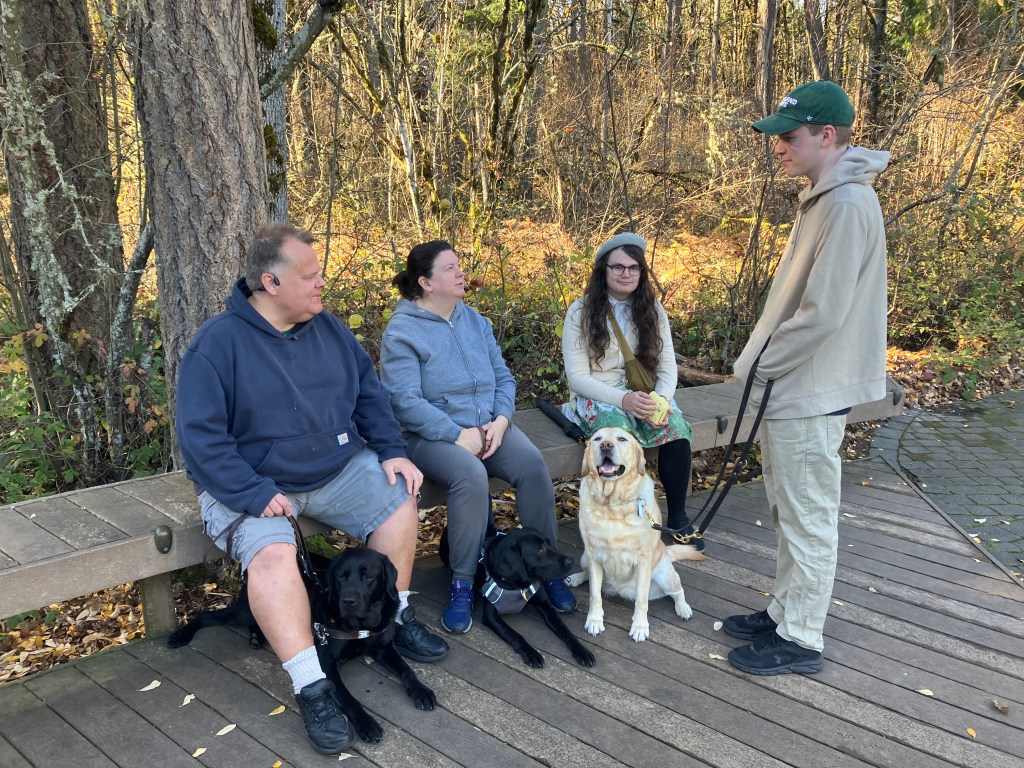
Nik asks me where our trainers are but I don’t know. But I feel their presence. I thought they might come and talk to us. Nik decides he is going to text Kat and see if he can hear the ping, and I realize he doesn’t even know that Kat didn’t come with us, and I tell him but I don’t even know who it was that came with us. I don’t know their names. We laugh about this. But then we decide to head back.
Here is where we make a mistake. Upon crossing the street again, Nik screwed up. But so did I. Usually, on an unfamiliar intersection, I would stand there in silence and listen to it a few times and figure out when the left turns go, whether they are right turning on red, etc. But this time I don’t because I am so insecure about these people following us and my dog wants to go and so I am physically holding her back. I said something to Nik, I don’t even remember what. I think it was something about how I need to figure out this intersection. And Nik and Cobey just go…right out into traffic with a car coming. He thought I said I was going but I was saying I was not understanding it yet. I yelled at him and he came back. No one was hurt. But there was literally no intelligent disobedience from either dog. This was our mistake, and we take responsibility for not just shaking off our insecurities and just taking our own time to figure out the intersection. But it brought to light a bigger problem.
When we got back, the trainer got on Nik’s ass about the intersection. Which, fair enough. But I was thinking, “You can say we screwed up that intersection and that’s fine. But are you not going to EVEN ACKNOWLEDGE that Cobey completely screwed up that intersection? Or that all Mia wanted to do was to pull into traffic? Are we not even going to talk about that these dogs don’t know intelligent disobedience? It’s just all going to be our fault?” Also she said that in a few MONTHS, maybe Mia could find chairs. This made me depressed. My other dogs could target in just a few lessons. Days or weeks, not months.
Also, here is the directions to that Starbuck’s, from t he corner after the intersection, the blind people way.
After crossing the street both ways, you will travel past a driveway, a building set back from the street, and another driveway. There are a group of hedges lining the sidewalk where Starbucks is. It is its own separate building with a small seating/patio area in between the hedges and the building. There is a flagstone path in the middle in a break from the hedges. Turn left down that path and the door is about 30 feet ahead, up a step or two.
But I digress.
The attitudes at the guide dog schools is that they are always right and if there is a problem, you are the cause. And sometimes you are. The dogs don’t know you, you are unfamiliar to them and your voice and body language is different. Of course there is a learning curve that is not always going to go smoothly at first. It is also hard to start over with a new dog, and it can be frustrating. but I am talking about if you have any criticism or feedback whatsoever about the dog’s training, the staff turns it onto you.
I’ll admit, there were a couple of times I made sort of a snotty comment. Or kind of a comment to myself that was not very tactful. It was mostly out of surprise and confusion. For example, Mia had diarrhea the entire time I was there and no one seemed too concerned. She also pooped by walking in a circle, dripping little drips of poo 360 degrees around me. It was almost impossible to pick up. For a blind person, you want your dog to poop solid and in one place. It can be hard to impossible to find poop you can’t see when your dog is a moving target. No one seemed to be at all concerned that my dog was doing this. So I said something. I thought she might have worms or something. I was instead told that I have to hold on to her collar while she poops so she won’t move. I said, sort of under my breath, “Oh. Now I have to teach her how to poop.” I had spent the previous night literally making a spreadsheet of all the behaviors I would like her to know and how many she did know and how many I would have to go home and teach her. It was a little overwhelming. So that is where that comment came from.
And that is how I kept getting sent to the principal’s office. And poor Nik, who was kind to everyone, got sent with me, totally guilt by association. And I did get the threat: “If you don’t like the dog we can just quit right now, no harm done. You can go home.” Like I’m five, and if I can’t play nice then they are taking their ball and going home.
Ok, I said a comment or two like the one above. But mostly I was nice and polite and did every single thing I was told. After the first principal’s office visit I had a FEAR that I would screw it up for Nik who already loved Cobey. I could not do that to him after he had already gone five years. But for the most part, I asked questions and was confused. Legit confused as to what was going on. Why don’t you know what commands this dog knows? Why don’t you teach them this? Why don’t you have higher expectations of the dogs and blind people? What should I do in this situation? I’m confused because you aren’t giving me any direction. What can I do about this?
The problem I think is that guide dog schools are praised SO MUCH about their wonderful work by everyone, including blind people who. have no power and always are at risk that if we don’t act like everything is wonderful that our dogs will get taken from us, that we pile on the acolaides as well. Sometimes with good cause and sincerely, sometimes, to stay in the good graces of the schools. So if you question the slightest thing, they are so taken aback that they think you are being highly critical of them when you just want it to work. You are depending on these dog for your every safe movement. For your self image as a blind person. For the good graces of others. And you are just supposed to smile and never say anything? These are my legit questions and concerns in an attempt to get a working guide dog that won’t put me in physical danger or further get me discriminated against. Don’t I have a right to have high standards and have some accountability?
In the last few days of training, I started piecing together Mia’s story. And it started to really piss me off. She was raised by a family in North Carolina, and from what I can tell, that went fine. Then, she went to the breading program, then she went to the running program, then she went to traditional training, then she changed trainers and was just sort of shelved and put into maintenance training for months. She had been in the kennels for 10 months. She had made approximately 7 transitions with different programs, trainers, etc. She was 2 years, 2 months old and for the past. year, all she had known was the kennel and several different trainers. She had done nothing and learned nothing new since at least June, except for regular maintenance walks. I was pissed for her.
There is this theory that labs don’t care who they are with as long as someone feeds them. I think labs are resilient in this way, but I also think they do get attached, it does matter when they are constantly separated from people over and over again and they do. have feelings. I know I can’t possibly know how it is to be her, but I do see now how it is that she is stuck in the kennel, afraid and ambivalent to socialize at all with the people around her except if they offer food. Food is probably the one constant she has had all of her life. No wonder she acts like a damaged foster child. In dog terms, that is pretty much what she is.
On one of the final days there, when I had pulled together what I could of her story, I got a little freaked out. This is the oldest dog I’ve ever gotten, who knows the least, who has the most behavioral problems, and who will take the most work, and who doesn’t even give a shit about me if I don’t have the food pouch with me. By the time I fix her, she will be ready for retirement! I am a middle aged woman with kidney disease. What the hell am I even doing?
I was sitting on the cold linoleum floor of my dorm room right in front of Mia’s kennel. She was curled up in the back as usual. She had peed on my floor earlier. I reached in to pet her, which she didn’t seem to mind, but also could take or leave. I was practically half way in the kennel by now, and I rested my head on the mat beside her. What would happen to her if I didn’t take her home? She would have more kennel time? Would she go back to her puppy walkers? Had she been with another blind student and be rejected before (around June as I kind of suspected?) Would they hold her over for another go? Would she be more screwed up? More damaged?
Maybe it would be better for her to be given back to her puppy raisers. They already had one rejected guide dog. They would take her, I think. But what if they just kept her in the kennels even longer and tried again? I knew they would never tell me what would happen to her. I didn’t want to go through another Barley. That was so hard.
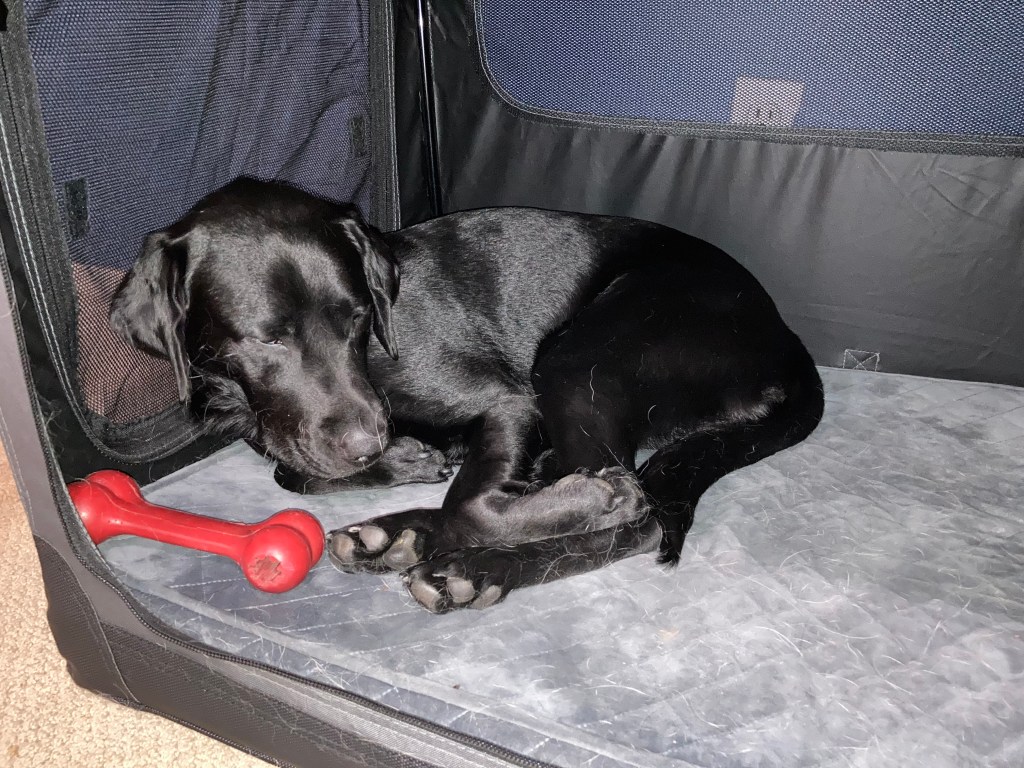
One thing I thought of was that I am now able (unlike many other folks) to work with her at home. I don’t have to go right back to a 9 to 5 job. My schedule is flexible. I had Marra, who could maybe do some modeling (which she did while she was with us.) I could never. have taken her home if I had to go right back to a traditional job or had small children. If she went to someone else, they might not be able to deal with her and her attachment issues would only be worse. And she did like to guide. She could learn. I had seen glimpses of it. I just couldn’t put her back in the kennels. I had to try to salvage Mia.
The Facilities
Again, I don’t need much at guide dog schools. It doesn’t need to be a resort. And although GEB’s facilities were adequate and safe, they were the most run down of any of the schools I had been to previously. To the point were Nik. and I were like, are they running out of money? Is there a problem? But the dorm itself wasn’t the biggest issue about the facilities that I found problematic.
GEB has no on campus training capacity. There is the road with no sidewalk, but that isn’t really realistic for much. (And they don’t teach the dogs to stop when you turn the corners on sidewalk less roads, so what could you even do there? It’s another thing on my list for Mia to learn.) But they only seem to use the nearest town a bit and it’s not very dynamic. We went to several other towns in the van. White Plains, Mt. Isco, etc. You spend a LOT of time in the van just driving to these places, just to find regular sidewalks. This is a negative of this training center. Too much time in the van driving, not enough time training.
At GDF, we got about 4 walks a day, some were fairly long. At GEB, we got 2 for maybe 20 minutes. it was the least amount of actual training time I had ever had. The ratio was 2:1, but that didn’t help. It was because of the driving time.
…and the wait time while the trainers had to do some type of data documentation. I’m all for accountability and data collection, but when the data collection actually changes and harms the training because of the time it takes up, it is no longer meaningful data. The amount of training, as well as the fact that the trainers were inconsistent and didn’t know the dogs and what they do well made this the weakest guide dog training I had ever had.
Graduation
This graduation still did not beat the GDB graduation for shear objectification and condescension, but it was not my favorite. It was a low key ceremony with an audience and also broadcasted on zoom and Youtube. It wasn’t terrible, but was not my favorite experience. Just like at GDB though, the dogs were hard to control and one poor dog was whining and crying a lot, but we all were supposed to act like nothing was wrong. It’s just like, why put the dogs through this? At a reception, that dog could have been right next to his puppy walkers and had a nice conversation.
The other thing that was hard for me is that every once in a while, you’d show up tired and looking dumpy just wanting to get through a meal and there would be some big wig donors that would just appear without warning and sit down next to you and start talking to you. I don’t mind meeting new people and I understand the part blind people need to play with guide dog donors, but just some warning or a request would be nice. It is hard to socialize when you are Deaf and in a loud room with a lot going on. So often, you could barely eat your meal because of so many guests and interruptions.
Bringing Mia Home
I already talked about the first few hours of bringing Mia home. It was rough going for awhile, but it has slowly gotten better. I’m only about 7 weeks out, so who’s to say how far we will go at this point, but I am hopeful. Here are a few highlights and lowlights from bringing her home.
- The fun at first was that she peed in my house all the time, all while spending almost all the time hiding in Marra’s kennel. She chose Marra’s kennel even though she had her own. Luckily, Marra never uses it since Sully died and didn’t seem to care at all. It seemed like she couldn’t hold her pee for very long at ALL and she also did nothing to communicate to me that she needed to go. I solved this problem by taking her out about every two hours and slowly lengthening the time and keeping her on a strict schedule.
- There was also a lot of barking and play fighting at first. Mia can be very aggressive, not to the point where she would hurt anyone, but she is very domineering to other dogs. We mostly solved this problem by time outs when it got too wacky, and letting her play fight outside but not inside. It was mostly between her and Cobey. Marra mostly stayed out of it and came over and sat by me.
- The most fun and biggest change is that she slowly did come out of the kennel and has become really affectionate and her personality is coming through now. I think there is still a bit of work to be done, but over the weeks, she came out more and more and interacted with us more and more. She now is almost only in her kennel at night time, which I am having her do because she will still have the occasional pee accident when I don’t. But she is a lot of fun now, very silly and sweet, and seems to enjoy being near me and other people in the family. She is still nervous when a stranger (like a waitress or a nurse) comes near her and will not sit still for it. She hovers behind me. This has gotten a bit better in restaurants as she has learned that the servers don’t really do anything to her. But we are still working on medical settings. She doesn’t like it when the people approach me/her.
- We were doing triple dog obedience every day when Marra was here and she had fun with that. Mia is the best of the three dogs on obedience. Marra was second best but a bit rusty. Cobey has had food issues and gets too crazy and aggressive around food to the point of distraction. Mia is labradorish around food so we use that to our advantage. Now that Marra is gone, we still do obedience, but I have to say it is not as fun as three dogs.
- As far as guiding though, the first few weeks were spent teaching her how to avoid obstacles. This is something I never thought I would have to do. When a guide dog changes handlers, especially if there is large difference in size between the trainer and the new handler, this is to be expected. But mostly that is just that the dog needs to learn your size and you might brush up against things. With Mia, it was like she full-fledged did not understand obstacles. There is this street light pole in the middle of a sidewalk I walk on all the time. And she runs me into it often. The first few days I took her out to work on targeting, but I had to back track and work on avoiding obstacles. It was crazy. It is getting better, but still surprisingly bad some days.
- Mia is good at finding curbs, but not so good at walking straight lines. No guide dog is perfect. But with my past dogs, they would walk straight down the sidewalk and every so often might get distracted by a smell. With Mia it is a constant thing, all the time. Instead of a straight line with an occasional head turn or sniff, it is constant sniffing and walking in a goofy fashion. This has improved somewhat but it is still a constant thing. One thing is that she didn’t come knowing very many “redirect’ commands that I was taught. I was taught hopup, but that was it. No leave it, no straight, no find the sidewalk, no find the curb (there is to the curb, but I was told you can only use that if you are within about 10 feet from the curb. I would use it as a refocus thing with my GDF dogs to give them focus.) You can do leash corrections, but it is so much more effective to keep them to what you want them to do as a focus rather than just jerking them away from what you don’t want them to do. We are working on distractions with the words I have used in the past. She is getting the hang of it some days.
- We are working on managing her speed/pull. Guide dog schools do a lot to match your pace with a dog’s pace, but what is more valuable is a dog that can match different speeds in different contexts. I am confused as to how much work was done with them to have methods of speeding up or slowing down. I would normally say “hopup” to speed up and “steady” to slow down. But I could not determine from my work with Kat whether Mia was ever taught any sort of speed up/slow down words. She does not respond well to either of those words. Kat just wanted me to “pulse” her leash. But that doesn’t phase her much either. I have been experimenting with the traditional vs. unifly harness to seee which one gives me more control.
- As Mia gets to bond with me more and actually like me a bit, she is getting less dependent on food. Now, we often go short trips without food. She can usually do ok going away from the house without food, but sometimes struggles on the way back home. She will literally stop guiding at all on the way home sometimes unless I get out the food rewards. I’m unsure if this is because she just wants to walk more or if her trainers might have taken her out on harness but brought her back in heel. So, getting off food rewards has been a work in progress but I have felt good about our progress. She is responding more and more to just my praise.
- I have taught her how to target many things and she is a FAST learner. I am very excited about this. She first learned how to find the fare box at the train station in about 2 days. Then she generalized that to every other fare box. This was revolutionary to me. Yes, she can learn fast! Yes, she can generalize! No, I don’t have to back chain and take months to teach her to target. This has now worked (two or three lessons with food. So say I do it 5 or 6 times over 2 or 3 days, using a find and reward “good button” method instead of back chaining). She has learned the pedestrian signals, she has learned the Portland bus stop signs, she can get some trash cans (especially the ones made for dog poo.) This gives me a lot of hope about her potential.
- What is interesting to me about this is that the brand new stuff that I know she wasn’t taught before and I taught her from scratch (like pedestrian signals) she learned super quickly. But the stuff that I think she may have learned before (like avoiding obstacles and finding a chair) she is much less consistent on and very messy with. I’m not sure why this would be. I know that I am doing it differently that she probably was taught, and that must be confusing for her. But since I really wasn’t taught too much of what she knows and I’m mostly guessing, there is not too much I can do about it.
- She has decreased her barking quite a lot. And she is not so much of a bully any more with Cobey. She is pretty sweet and chill at home now.
- Her decorum, or manners are better now that I brought her home than they were at the school. Part of this is maybe to be expected. She might be less stressed now. Part of it is that I kind of have developed a no tolerance for bullshit policy with her, and I think they tolerated a lot of nutty dog stuff there without really having too many expectations for good behavior, or at least as good as I’ve been used to. So this has been a relief that she does sit on the bus with good manners. But it took me being kind of hard ass about it to get her there.

So, things are slowly progressing. But make no mistake, this is not usual or how it is supposed tone. She is the oldest dog I’ve gotten with the least knowledge of guiding and the most problematic behaviors from the get-go. I can only do this because I am in the position right now to not have too many demands put upon me as I sit around and wait for my transplant. If I had young children, a very busy life, an office job to go back to, I really couldn’t have taken her home to work with her. With Mara and Marra, I did not have to do even 1/20th of this work when I got home. There was no potty problems, obstacle problems, barking problems, food issues, etc. With Mara, I had to wait out her barfing stage, and with Marra, she chewed a few things up when I brought her home. There was a bit of work with customizing their targeting and that was it. I could hit the ground running and go on with my life. Barley was more work, but she could basically guide without running me into things. I didn’t fear for my safety with her. With Mia at this stage, I am very careful with where I go. I cannot yet take her places where I am “freestyling” it. I always need to have a cane to back up. And I am only taking her on 1-2 walks a day to familiar places at this stage. It has been and will continue to be a lot of work.
And yes, part of me really resents that I have been put upon to do this as if it’s nothing and as if it’s all my fault or that my expectations are too high. But I sat there, half in the kennel, trying to find whether my dog had any joy for life left in her, and I chose to take her home and work with her. I couldn’t face putting her back in the kennels for yet another person to leave her and transition to someone else. She does, it turns out, have a lot of joy left in her.
Mia’s Timeline (as best as I can surmise):
- Born August 11, 2021
- Puppy raisers from about October, 2021 to January 2023 (a note: I did ask if something in the pandemic messed up her timeline and made her have to wait at different intervals for extra long, or if the pandemic had affected the quality of her time as not being able to go so many places or. have less opportunities. I was assured that it had not affected her training. It was only the 2020 dogs who were affected. This would have been an excuse I would have understood, but they said no, the pandemic did not affect her, so?)
- Sometime in the breeding program (January 2023)
- Running program trainer and first trainer (February 2023 to June 2023)
- Maintenance trainer (June 2023 to September or October of 2023)
- In class with me (October 16-29, 2023) Total kennel time 10 months, over twice as long as any other dog I’ve had, and with more trainer switches)
- At home guiding (to present)Age 2 years, 3 months
Salvaging Each Other
If I could speculate on what happened with Mia, I would say the following issues contributed to her issues:
- Too many transitions of people/trainers
- Too long in the kennels, although I know she was not abused and was well cared for, kennel life is stressful for dogs. This, along with constantly detaching from a musical chairs of trainers seemed to affect Mia’s trust of humans and made her only understand food and trust dogs.
- Along with that, her second half of training sounded like it was essentially, a bore. Nothing new was taught. She was taken out for some walks, but not too much happened. it was such a waste of time! Think of the things she could’ve been taught during that time to keep her interested in life. Nik noticed when we got the dogs that their paws were silky smooth, like they didn’t get out much at all. In just the few weeks we’ve had them, they already have started getting firmer, calloused paw pads. None of my other guide dogs had such smooth paws. Another issue was that when we got them, they really stank. I do believe GDF gave the dogs a bath before we got them, but these dogs had not been bathed. One of the first things we did when we got home was bathe them. They were so happy! I think there was some real under stimulation in the kennels.
- No consistency among trainers or commands. It seems the dogs have different methods and experiences with trainers, and the final trainer (my trainer) did not really have any idea what they knew or didn’t know.
- Low expectations about what the dogs can do. Maybe not all dogs can do what Mara and Mara and Jats and to an extent, Sully could do. But Mia is smart and can do a lot more than they set for her to do
- Not a lot of quality assurance on how the dogs can perform with blind people who idon’thave a sighted fairy nearby telling them everything coming before hand. Throwing on sleep shades for an hour or two with another trainer walking with you on routes you and the dog already know is not real life. I don’t thing the trainers really know a lot about how it is to walk with these dogs as your main mobility device in real life situations. Also, blind people don’t just follow known, reapproved routes exclusively. There are different ways blind people have to travel and different discrimination we face when we have a dog that is not very well behaved. An appreciation for our reality would be nice.
If there is a grand plan in life, (and I’m not one that really believes in this but lets just say there is…) maybe Mia came to me like she did because Marra was going to die soon and suddenly, leaving me pretty devastated. Maybe I was supposed to help Mia because Mia was supposed to help me. Although there has been frustration, and sometimes I do have to give myself a pep talk to convince myself that I HAVE to take Mia out and not just use my cane because she needs the exposure and training, I have much enjoyed having Mia these past several weeks. We have much work to do, and I don’t know how far she can go as a guide dog, yet. But I think there is much potential there, and if we are supposed to salvage each other, then we’ve gotten a good start.
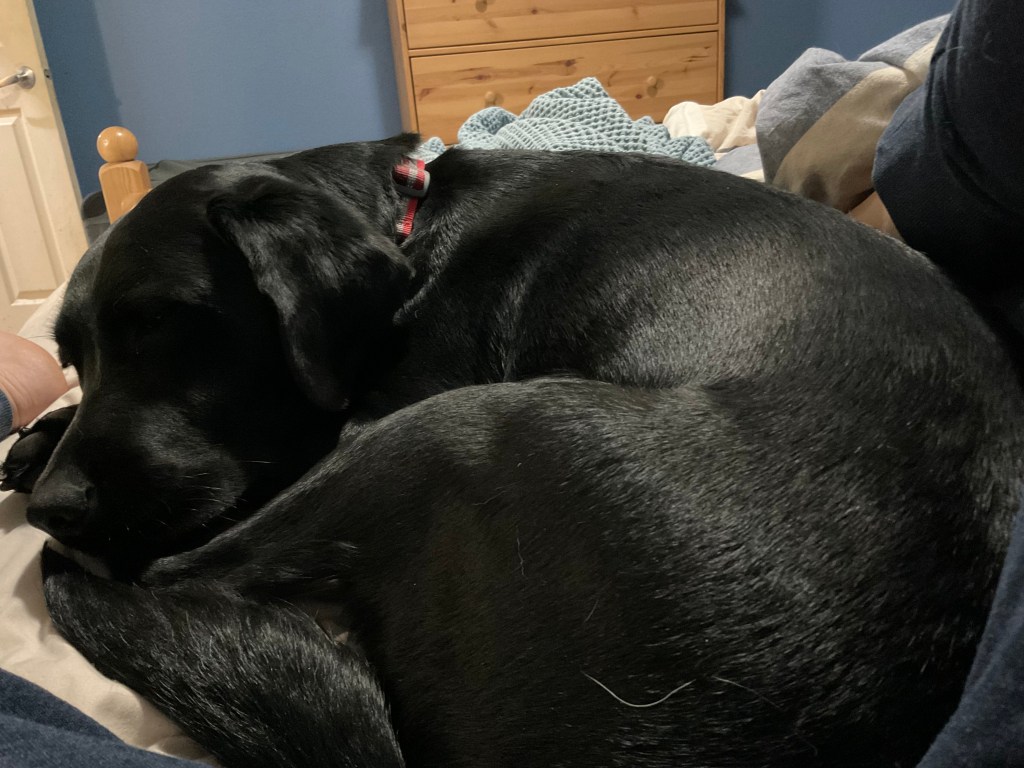
(For those who’ve made it this far in my little Guide Dog Minibook, I think I have one more short chapter left in me. I think I want to round up a list of recommendations for improvement.)
 Writebook