What’s the Matter With Guide Dogs? (Chapter 1: What happened at the airport?)
What’s the Matter with Guide Dogs? (Chapter 2: Mara and Jats, The Gold Standard)
What’s the Matter with Guide Dogs? (Chapter 3: The Strange Story of Barley)
What’s the Matter with Guide Dogs? (Chapter 4 Old School and New School Diverge: Sully and Marra)
What’s the Matter with Guide Dogs? (Chapter 5: Salvaging Mia)
Due to a serious lack of transparency and study, statistics about guide dogs are hard to find. According to Guiding Eyes for the Blind’s own website, about 2% of all eligible blind people use guide dogs. This number has always been low. There are complex reasons for this.
Each individual has to decide for themselves whether the net positives of a guide dog outweigh the net negatives. This depends on their own personal situation. Do they like dogs? Is their vision or their cane travel skills giving them enough problems to want to seek out alternative solutions? Does their lifestyle accommodate a dog? Do they have the time off from employment to pursue the training? Can they afford the expense of a dog?
Despite all the glossy stories showing teary eyed blind people who credit their dog with giving them independence and dignity (terms which grate the nerves), many blind people flat out don’t want to pursue it. And that number appears to be increasing. Also for complex reasons.
I tried to find data on whether guide dog use was increasing or decreasing or staying steady over time, but could not find good data. Some of the data seems to say use is decreasing, but with the pandemic, those numbers may have been skewed and it’s possible they may recover. There is also the stats of blindness prevalence itself. Type 1 diabetes, which used to be the leading cause of child and young adult blindness, has become much more sophisticatedly managed with the invention of insulin pumps and continuous glucose monitors. When I was young, almost all the young people I knew were blind due to Type 1 diabetes. Now, this is rare. Things like macular degeneration are increasing in older populations (apparently due to our LED lightbulbs and screens), but older people are less likely to pursue a guide dog (or a cane for that matter.) So, it is hard to say what is happening on a population level.
In my own life, where I speak to countless blind folks every day, I am seeing (admittedly anecdotally) a decline in a desire for guide dogs. Some of this might be because of the improved technology for navigation that has come about. Blind folks now have access to apps that help you cross streets, that give point-by-point walking directions, that tell you what stores and addresses and intersections are around you, and even access to live visual interpreters that can explain what is going on around you by having access to your camera. A cane is a very useful tool, much more useful than a guide dog, to explore the space around you and make sense of it. But a cane is also tedious and requires a lot of concentration on your part to keep track of everything. Guide dogs take some of the tedium and mental burden away. You share some mental responsibilities with the dog. But now, you can share some of the mental responsibilities with these apps, And they can be much more reliable and give much more specific information than a dog can.
But also, much of this is likely due to what has happened with the massive increase in discrimination and oppressive regulations around service animals. This is largely due to the “faker” and largely untrained emotional support dogs and the notorious emotional support peacocks and lizards that began showing up in airports and in public places, causing messes and mayhem where they went. It has definitely been something where abusers ruined it for the bonafide users. However, I also think that the decline in the training of guide dogs has not done us any favors.
In the 90s, it was extremely rare to ever be questioned about whether my guide dog was legitimate or to be refused service in a business, taxi, or airport due to the dog. Guide dogs actually helped lessen stigma and discrimination against blind people. People knew what they were, knew what the harness meant, and knew they were hard to get and so that you must really be blind and need them if you had one. There was literally no way to get a harness or service dog signage back then unless you went through a guide dog program. Now, you can buy that stuff off Amazon. People knew they were well behaved because their behavior was exemplary. It had to be, because until 1990, we did not have a lot of universal legal protection. (Many states had some laws, but the Americans with Disabilities Act of 1990 codified national service dog rights for the first time.)
When you look back to the history of guide dogs, which started in Germany after WWI for blinded vets, guide dog trainers and users had no protections and so they had something to prove. When trainer Dorothy Eustis and her first U.S. student, Morris Frank, started The Seeing Eye in 1926, much of what they did was to advocate and educate as well as put political pressure on lawmakers to legislate guide dog access. The dogs coming out of her program had to be above reproach. The blind students who used them also had to be above reproach. I imagine there were many people who could have benefited from guide dogs that did not get selected for programs because of the very high standards for both handlers and dogs. For decades, you were required to wear a suit and tie or wear a dress as a student at the Seeing Eye.
In 1993, it seemed like we were still sort of in the leftovers of that era of having something to prove and having to have exemplary handler and dog behavior. Since then, it seems there has been an overall devolvement of expectations all around, for the dogs, for the trainers, and for blind folks themselves.
Schools Low Expectations of Blind People
In my experience, this has always been a problem. And in some ways, this has improved over time. But there has always been a lack of respect and equity by the Guide Dog Schools in regards to blind people. On an organizational level, we’ve always been treated like shit. In fact, when I ask people who like dogs and are fairly good travelers why they don’t consider using a guide dog, this is the number one reason that comes up. They don’t want to have to put up with all the patronizing of the guide dog schools.
But first, before 500 people start telling me how great their guide dog experience is and how nice the staff was, let me explain a bit more. Oppression can be complicated. It can be stealth. It can be benevolent. You may have heard of benevolent racism or sexism. There is benevolent ablism as well. In fact, I think ablism is particularly prone to it.
A lot of people will describe guide dog school as a vacation. And I totally get that. You don’t have to cook or clean. Unlike the rest of the world, everything is made accessible for you. And people are nice. They are really nice and polite. And I am in no way saying that for many/most of the staff, it is insincere or part of some grand conspiracy to trick you into being duped into their secret condescension. I think the person who serves us food really wants us to enjoy the food and have a nice day. I think the trainers largely want you to have a good experience. For many, especially those who come from really shitty home, community or work situations where they deal with constant daily, hatred and antagonism because they are blind, this experience can be a revelation of good treatment. But the higher up you go, the worse the oppression gets.
The power differential is extreme. We aren’t like regular students who are covered by laws or pay tuition. We aren’t colleagues or employees who have some union or HR protections. We are recipients of charity. The prevailing underlying thought is that we have no rights and should only be grateful for our salvation by these white knights.
Now, it is tricky to be a beneficiary of charity. Of course there is room for gratitude. The fundraising PR they use often throws blind people under the bus to gain sympathy. Tearful people will talk about how they had no dignity and couldn’t do anything until they got a guide dog that changed their whole life around and gave them a life again. I mean, there are people who legit feel that way and so be it. But there is also a lot of pressure to “put on” that show and be that person. In doing this, it makes blindness look like a fate worse than death and if you don’t’ have a guide dog, you cannot function in society and you have no dignity. They will often show someone apparently struggling with a cane by getting stuck behind a door or getting tangled in a bike rack or something. These things do happen. But it has nothing to do with our dignity or independence. That is how blind people who use canes move. Usually you are not that tangled, but when it happens, who cares? There has been a lot of hatred, discrimination and stigma surrounding just how blind people move. There is nothing wrong with how we move or how we use our canes. There is no moral or ethical value here between how a cane user moves, vs. a dog user, vs. a sighted person. But the guide dog schools use propaganda to make it sound like traveling with a cane or moving like a blind person moves is a fate worse than death. This rhetoric is damaging out in the world. There are legit advantages to having a guide dog. In fact, recently a volunteer of a guide dog program asked me what the benefits were to me as a guide dog user and I gave her paragraphs of them. She commented that this was the first time someone actually explained the true advantages of guide dogs in a practical way without just giving the tearful dignity explanation. I think funds can be raised on the truth about guide dogs. Not a lie about how you don’t have dignity unless you have a guide dog.
You are also constantly being told that a guide dog team costs anywhere from $40-80,000 and there is no way you will ever be able to pay that debt back. You are therefore at their mercy and you have no say. Yet, we are then supposed to trust completely our lives and wellbeing to these dogs with almost no control or transparency into their level of quality.
And quite frankly, we do give back. All guide dog users are on some level, ambassadors for guide dogs and their particular school. Many take it further by doing public speaking educational engagements, recruitment, and word of mouth referrals. Everyone answers a million questions from the public and everyone does a level of fundraising, some by just talking about their dog in public and others by participating in fund raising events, hosting their own events, and donating money themselves to schools. My sister and I sponsored a GDF dog together, I have participated in walks and gofundme type events and have done countless guide dog presentations in schools and community organizations. Nik and I organized a guide dog info and recruitment fair at our local agency for the blind. MOST guide dog users have done these things on different levels. For Free. Is it $40-80,000 worth of free? Who is to say? Ask Haben Girma or Erik Wehermeyer what their speaking fees are these days. Yes, they are more famous than most of us, but I still know what kind of fees my business partner and I can get for some of our simple intro AT workshops we’ve done. I know some of the fees my blind colleagues who do DEI presentations can get. Yes, I think that many of us, if we could monetize all the free PR we’ve done for the schools, contribute enough time, expertise, and ambassadorship and recruiting and fundraising to earn pretty close to these amounts over the lifespan of our dogs. If all of that went away, it would be interesting to see what would happen to the bottom line. I believe the work we do for the schools is worth something. I don’t know that most of the leaders of these organizations have considered that.
I get that fundraising is hard and takes a ton of work. I get that pleasing donors and volunteers is essential. But they aren’t your customer base, WE ARE. Also, unless you are going to change the nature of your nonprofit and your mission, you aren’t in the business of selling dogs, either. I’m not saying it is wrong to sell dogs to the police or other schools, but that isn’t your main product, right? WE ARE. Nik totally thinks that the guide dog schools are only doing classes of like 4-5 people because they are making real money (apparently $15-45K per dog) selling to selling dogs to police and other working dog customers. I don’t know if that is why, but it does feel like a LOT of dogs are being bred without a lot of blind people matches being made. Is this becoming the focus of these orgs and guide dogs and blind people are almost the afterthoughts? I can’t say, it’s just a theory I’ve heard, but maybe it is one explanation for the deterioration of guide dog training?
Without blind people, there is no guide dog school. There is no guide dog trainer jobs, there is no raising of funds, there is no organization at all. I am not implying that blind people should not be appreciative for the free services they are getting. And I actually do feel an obligation to give back. And I will work harder for those who can’t do the work I can do. (And for those who say this series of Guide Dog posts is the opposite of good PR, maybe. But it has also been a labor of love for the whole concept of guide dogs. And all the people in the field. I’m trying to help you a bit by holding up a mirror to your face. You need to do better.)
Blind guide dog users are essential, the most essential part actually—of the whole guide dog industry. We should be treated with more respect, more transparency, and higher quality services than I’m seeing lately. To give you just one simple example of what kind of stuff is happening, I’ll share this experience with you:
For decades, blind people never owned their own dogs. This actually caused problems for many people. Some reported dogs taken away from them because they were thought to be a poor match. Or for mandatory retirement. Or dogs that were euthanized without the blind handler’s knowledge, or dogs that were taken away because of reports of abuse but with no due process. Being the central decision maker with access to due process is key here. There are still local laws and animal services as well as veterinarians that have the authority to deal with abused or sick dogs. But ownership matters. Even if most people will not ever deal with any bad situations, it is still insulting that we are still not thought to be trusted competent adults that can own our own dogs that we spend the majority of their lives caring for.
The vetting process to get a guide dog is more extensive than the vetting processes I’ve been through to get into college, or be a teacher, or work as a state certified home health worker. All the schools are a bit different, but here is what most require:
-Initial application with questions about your blindness, travel skills, guide dog history, overall health, employment, housing, lifestyle, finances, criminal history, etc.
-evaluation of your travel skills from an orientation and mobility professional
-1 to 3 letters of recommendation
-An extensive physical examination from a medical professional with a full report of your medical history and current status, vaccinations, etc. I’ve even seen sexual history on these forms.
-A phone interview with a staff nurse
-A phone interview with a trainer or other staff
-An in-person visit where your home is inspected for suitability and your travel skills are evaluated in a walk around your neighborhood and street crossings, etc.
-Two to four weeks of in person training where they control our schedule 24/7. We eat and sleep and shower there, we are evaluated constantly. Notes about our behavior are written and given to the proper authority. They lurk around at times and don’t even tell you they are watching you. No, I don’t think they have cameras in your room, but they do have key access to your room. There is no privacy.
-Within the training, we are continually evaluated by trainers and nursing staff. Interviews with the nurse, the trainers, the directors of training happen often and are required. Competency with the dog is evaluated. Data, never shared with us, is taken.
-After graduation, there can be follow up visits from training staff, progress calls, and mandatory veterinary reports.
Just to be clear, I’m not even necessarily objecting to most of this (although some of it really IS excessive and a violation of privacy). What I object to is that all of us have been thoroughly vetted on multiple occasions. If we were not suitable to ethically care for and handle a guide dog in this year long vetting and student training process, well then you’ve had your chance to kick us out. If we have passed the muster to graduate, then give us ownership of our dogs upon graduation. Don’t hang a power trip over us the rest of our (dog’s) lives. Because that is all it is, a power trip. I’ve been trusted to take care of people’s disabled children with less vetting than this.
This is patronizing ablism.
I about jumped out of my chair and stabbed a guide dog staffer about this issue, (ok, not really. I’m a pacifist. Don’t take my dog away) because he was basically gaslighting and lying to everyone about this. He presented the ownership issue as if there was no real reason to own your dog, it didn’t matter, and it was better for you to let the school retain ownership. (At this particular school, ownership could be granted in two years IF you request it. I already have a note in my calendar for my exact two year anniversary with Mia so I can “request” to own my own dog. The dog I’ve spent much of the last 8 months training myself.)
When I mentioned the due process issue and some of the problems others have had not owning their dog, he poo pooed them with some assurances that they can’t just pound on your door and take your dog. Perhaps not, but I know what can happen afterwards if there is no due process. Then he went off on some stupid straw man about how nodogs should be property anyway. Well, that is not the debate we are having and that is not the world we live in and you are a gaslighting, lying condescending, ablist ass. No, there is really no other excuse for you. You are saying this right in front of a lawyer who knows better (not me, my classmate. But every single student in there knew better and knew he was full of shit.)
Look, in most cases, I don’t think these problems ever come up. I don’t think they are trying to take back people’s dogs on a whim. But it is a matter of respect. And by holding the ownership thing over our heads, they are showing a complete lack of it for no other reason than that they do not trust, respect or think of blind people as their equals. Blind people have fought hard over the years for guide dog ownership and due process and that is for good reasons. Some schools do now have ownership upon graduation, as it should be. Other schools need to take a good hard look at how much they are discriminating against and loathing the blind people they purport to serve.
Another thing I would like to say about respecting blind people. I think I am an average blind person. I do OK. I have some additional stuff like hearing loss and kidney disease, but generally I’m average. There are a wide variety of blind people out there. Some with other disabilities, different levels of functional vision, different educational opportunities, socioeconomic backgrounds, etc. A lot of times when I have complained about guide dog schools, or anything blindness service related, I get a version of this one comeback which I would like to just shut down right now.
People say stuff like:
“Not everyone has vision like you do.”
“Not everyone has your level of success.”
“Not everyone has your Orientation and Mobility Skills”
“Not everyone has your level of determination or moxie.”
“You don’t know what it is like to work with the people we work with. Some are very challenging and need a lot of support.”
Ok, first of all…I help run an AT training service that works with blind and disabled people. YES, I DO know what it is like to work with a wide variety of people who have a wide variety of skills, problems, levels of functioning, whatever. I not only work with these people, I am friends with these people. They are my community.
If some people are just too much for you, you had your chance to eliminate these people in your vetting process if you didn’t think they could handle a guide dog. (We don’t get to do that, by the way. We take everyone.) So, if you accepted them into the program, treat them with the respect they deserve. Respect is more than basic politeness. It means treating them like adults who have capacity and self determination and deserve full information and responsibility. Always presume competence. Acknowledge the imbalance of power and risk of oppression under those circumstances, and double and triple step back your power with intention and make sure that you are not manipulating them or treating them poorly.
I am all for meeting people where they are. That’s fine. But just because people have low skills or functioning or whatever does not give you any type of justification for being disrespectful to them. Yes, there are people who’ve had lousy or almost no education. Yes, t here are people who have additional disabilities, a lot of learned helplessness and don’t function well without a lot of support.
So what? None of that is justification for treating people in condescending fashion and being dishonest, patronizing and ablist. Saying that somehow I deserve more respect and self determination because I am a bit more independent or have some better advocacy skills or look less blind or can travel a bit more independently is bullshit and you should be ashamed of yourselves for putting some arbitrary goal post on equal treatment. Everyone has inherent worth and dignity. Be upfront with people. Adjust your language if need be for better comprehension, but give people the same level of information, respect and decision-making power as you would anyone else. You don’t deserve less rights because you function at a different level.
If you think you are complimenting me be giving me the “not everyone is as relatable to me as you are because you seem higher functioning and less disabled, and that is why I give you special privileges” or whatever…you are not. You just outed yourself as an asshole.
Schools Low Expectations of the Trainers and Dogs
Every guide dog user I’ve talked to that has been around for the past 30 years or so has talked about how the quality of guide dog training has gone down hill. My theory is that it is partly because of the much lower standards in general for the proliferation of service animals and ESAs. They are more protected by law and so we aren’t fighting that battle anymore so who really cares how the dogs act, I guess. But honestly, I’m really unsure of the reasons. I’m sure it is also complex.
But I will say that it doesn’t seem like the trainers really get blind people’s real lives, and they also do not spend NEAR enough time getting good O&M skills that include spending time blindfolded both with cane and dog and WITHOUT a sighted person walking along with them telling them every thing that is coming up. It also seems like they don’t spend enough time on diverse routes and do the same routes over and over with the dogs instead of traveling with them in unique places. Dogs generally like routines. Any dog can guide on a route they’ve done 100 times. A guide dog needs to work in unknown settings, without sighted assistance.
I think they all should have at least 3 months, full time 8-hour day, under blindfold to learn how a blind person lives. This includes meals, buses, cars, walking, shopping, etc. Ideally this would be done with highly skilled blind instructors, not the very low skilled and low knowledge sighted people that typically get TVI and O&M certification in like 2 summers with almost no blindfold time. After learning with a cane, then they need to spend substantial time with each dog they train doing this. I get that at the beginning of a dog’s training, a sighted guide might be necessary for safety, but really, the last couple of weeks of the dog’s training should be entirely under blindfold and without a sighted trainer walking along side and without using the same routes over and over. That just isn’t real life. As a person who had a lot of vision when I was younger and still has some vision at least during the day, I know that guide dogs area very influenced by subtle reactions to visual stimuli from the handler, body position, tensing up, being told something is up ahead, etc. They need some exposure to having someone just not know where in the hell they are and have to figure it out. The dogs used to seem like they had some of this, but now it seems like they have none.
I feel like trainers think that we go to the same 2 or 3 places every week, never divert, never run into construction, never have to change routes. We never have to change our pace due to injury, the circumstances or walking with a slower person. I also feel like they think we never carry groceries, a baby, a child’s hand, or talk to a friend as we walk so that all of our attention and both hands are fully available for the dog. It seems like they think we have the time and inclination to give the dog treats at every curb because as long as they stop at a curb for treats, they are a guide dog. They don’t seem to even get why they are stopping, or have a proper fear of cars. They don’t seem to have intelligent disobedience anymore, and I think the only way to get that is for the trainers to actually go out with them under blindfold and without sighted assistance. Yes, maybe you might trip or bump into something. Guess what? If we get dogs that aren’t trained well, that’s exactly what happens to us. And no, we do not have a constant supply of sighted people to walk beside us and tell us everything that is coming up, what every intersection looks like, and when we are going to smash into a wall.
The blase attitude some trainers have is an insult when you consider that we have to use these dogs (in conjunction with our own skills) as safety tools. When my dog does something absolutely dangerous, don’t downplay it or blow it off. Yes, you were here now to prevent bodily harm, but have one iota of appreciation that I have to go home with this dog and travel with it solo.
Also, have a little respect and recognition for the overwhelming amount of discrimination that a blind person faces on a daily basis. The days in which a guide dog deflected some of that discrimination are largely over. Now, using a guide dog adds to the discrimination we face. There are always a few dog lovers out there who will love us and our dogs even if they pooped on their face. But they are actually the minority. Another minority hates dogs, but most are generally OK with dogs if they are not a nuisance. So, except for the serious dog lovers, the vast majority of people we deal with WILL and DO hold it against us if our dogs act up, shed, sit on a car seat, constantly get up from the bus floor or restuarant floor, bark, pee, guide us sloppily, etc.
DECORUM MATTERS. Quit minimizing it when our dogs do stupid shit right in front of you like it’s no big deal. Dogs can behave if taught well. Many of the dogs coming out now are not taught well. I always feel sorry for the young first timers I see all over Portland with their GDB dogs. Because the dogs act absolutely atrociously and the young people don’t know better or how a dog can act or how to make their dog act that way. Those GDB dogs are the ones that keep people from getting jobs and from getting taken seriously in doctors offices or banks or college classrooms.
People will look for any excuse, ANY reason to discriminate against a blind person. These poorly behaving dogs give them about 70 excuses to not offer the same opportunities to blind people as they do the nondisabled. Thirty years ago, the dogs used to sometimes help. They would walk into a job interview smoothly and with grace, point you to a chair, then sit quietly under a chair the entire time, unnoticed. It could be a conversation starter. It isn’t like that anymore. Now the dogs are fumbling around, getting in the way, making the blind person look incompetent or awkward. All the controversy around service dogs and ESAs make people not even want to go there. Uber drivers won’t take you, etc. Without finesse and decorum, a guide dog is a hindrance that will cause more discrimination, not less.
Trainers act like everyone is going to love our dogs and welcome us with open arms. That only happens in the insulated world of guide dog schools where trainers, donors and volunteers are all dog lovers. That is not how the real world works. How these dogs graduate with no proper indoor manners is beyond me. There is always the burden of having to have the dog with you and take up space and be cared for. That can be offset if the well behaved dog gets you down the hallway and into the chair elegantly. If the dog is all over the map…well, imagine how you would like to go to job interviews with your toddler climbing the walls? Now imagine taking your toddler when you know you are already climbing uphill because you are blind. I don’t understand why decorum and finesse is hardly taught anymore, but it is arrogant and kind of privileged that the schools don’t even consider what blind people face as far as discrimination and how guide dogs factor into that.
Also, guide dog users, especially alumni, know that the process of training is stressful for the dog and that they are going to do nutty stuff while getting used to a new person. However, sometimes we can see real problems that go beyond that. When a dog has clearly not been taught certain skills or is acting in ways that are way beyond what a guide dog should do, even if stressed out, don’t always act like it’s our fault. We can work with you to try and solve these problems, combining your level of expertise with our experience as actual guide dog users. But if you just deflect all responsibility and act like it’s all our fault and we are just doing it wrong, then no one gets anywhere and any real learning gets shut down. If we ARE doing it wrong, then tell us the right way to do it, don’t just say it’s all you and you are wrong. If you don’t have a constructive correction for us to do it right, its a real tell that the dog really doesn’t know how to do it and you don’t have a way to teach them anyway. Assuming competence is always better than the inverse.
I don’t pretend to be an expert on training or breeding dogs. I know I don’t know all the factors that go into what makes a good guide dog. I just know a good guide dog when I see one and they are getting rarer and rarer. But dogs can be held to higher standards than they are now. They can be motivated by praise and the bond with the handler. They can basically understand the overall job of getting themselves and their handler safely through the world. They can target things and they can sit nicely when not fully engaged in working. And they can travel off-route with a handler who “freestyles” more often than not.
If not all dogs can do this, then actually match dogs to people’s lifestyle, not just pace. Pace changes so much that it’s is more important to train a dog to match pace than to arbitrarily match a dog to a pace you took one time in very controlled circumstances. Keep the dogs that are the best for the people who do the most traveling. Put the route dependent dogs with the route dependent handlers. Put the lower performing dogs with the folks who get sighted guided 95% of the time. And be transparent about this so people know what they are getting and why. But in all cases, there should be a basic high standard for decorum and basic guiding.
Here is another idea. Marra, my second dog from GDF, was trained to my specifications. I had an extensive interview with her trainer, the only trainer she had and who also trained us together. My interview was about three months before I was assigned her so she had only recently started training, and then she was trained with me in mind and to what I had requested. I know that probably can’t be done perfectly every time, but a lot more of that could be done. If you have too many dogs going to too many trainers, any quality assurance gets lost, and any personalized matching gets lost, too.
Also be transparent about how many dogs are rejected, how many get returned and why, how many successful pairings, how long each dog is in training and what happened in their lives up to the point of class, why the choice was made to pair, and just overall share information as if we are equal and respected partners in this endeavor. If we are supposed to choose a school to train a dog that either can assist in our safety or put us in danger, or assist in our acceptance or increase our oppression, we have the right to know these things to make good choices. In general, there needs to be accountability in guide dog training, ,and blind handlers need to be front and center in that process of accountability, not a powerless afterthought.
Is there another guide dog in my future?
Nik and I have both said we don’t know if there will be another guide dog for us. But we have both put off the decision until the time comes. I’ve loved all my dogs, and the guide dog relationship is special. But you have to weigh the pros and cons. It is not near as balanced to the pros side as it was 30 years ago. Every time we go anywhere, we think dogs or not? Before, we wouldn’t have ever thought of not taking them. Now we try to weigh the risk factors. Are we going to use an Uber? Because that can fuck up your whole day. If I absolutely have to get somewhere by a certain time and I have to take an Uber, the dog can’t come. It’s just not worth the risk. Traveling by airplane is frought with issues now, too. We brought the dogs to Nebraska because we were going to be here a long time. But in doing so, I nearly lost the kidney I was offered. Twice, we had to fight tooth and nail with tears and everything to be allowed on the plane. It was an awful mess and a risk I was trying to avoid. But now, for short trips, we’ve been finding them a dog sitter rather than take them on the plane. Flying with guide dogs is a nightmare now. Are we going someplace they have been before and have proven to do a good job at? If not, we might consider figuring it out ourselves with a cane. Is their possible poor behavior going to be a problem where we are going? If so, we might leave them at home. Is the conditions too hot or too cold or otherwise going to be difficult for them? In the past, we might have asked for a favor from someone there to help us out. We often no longer can count on that grace because everyone is sick of “so-called service dogs.” It’s just a different world now, and with different dogs. We love them, but their utility to us as guide dogs is not what it used to be.
It’s a difficult thing to apply to get a dog, which takes about a year, do the two week benevelent, but still minimum security prison duty, do what used to be 1-3 months but now seems to be 1 year of additional training at home, then you maybe get 5 years if you are lucky, then they start to decline, get old and die. Repeat. There are some AI, robot guide dog solutions that are being developed. It will take a lot for me to trust that technology, but if and when it works, I would so jump on that so fast.
Or if working with Mia has proved anything to me, it’s that I can train my own dog. I’m not saying that I trained Mia from scratch, because she did come to me with some skills, but I have had to train her from scratch in some areas enough that I am starting to get how I can do it. And that I totally could do it. Some of t he guide dog teams I know that are self trained are the best, most well trained teams I’ve ever seen. There is something to be said for training from puppyhood and that bond. Another area of discrimination is that guide dog schools often don’t let blind people be volunteer puppy raisers. I would love to train a puppy from scratch into a guide dog. What a unique experience! I’d need to do more research, but that is maybe a possibility.
Or, I’ve always enjoyed cane travel. I believe I can still—as I was taught—be dropped into a city and find my way out. I’m not saying I could do it perfectly every time or that I won’t get lost. But I have the confidence to do it still and when you are feeling good and you have the time, it is actually quite fun. A lot of people say that a guide dog gives them confidence. And I totally get the whole thing where sharing responsibility makes things easier and it is another bit of data to use when traveling. I get the high of walking smoothly down a street with a dog and making a perfect turn rather than running into shit with a cane. But I kind of think some of those folks are just so invested in vision being better than blindness no matter what, even a dog’s vision, that its sort of a placebo effect. I was just lucky to always be taught that sight is very efficient but that cane travel was an alternative, not sub par. So I always had that confidence that I could do what I wanted with a cane, too.
But I think I would mostly like for there to continue to be guide dogs in the future. It is a unique special thing and I’ve always thought it gives the dog a really nice, unique and high quality life as well as giving the handler some kind of almost intangeable level of information that I didn’t know can be replicated by an AI self driving gadget. I am afraid that if the guide dog world doesn’t shape up to face the challenges of the new reality of guide dog discrimination that is out there now, as well as the evolution of blind people understanding their own rights and how they deserve to be treated, it will eventually fade out and no longer be a viable option.
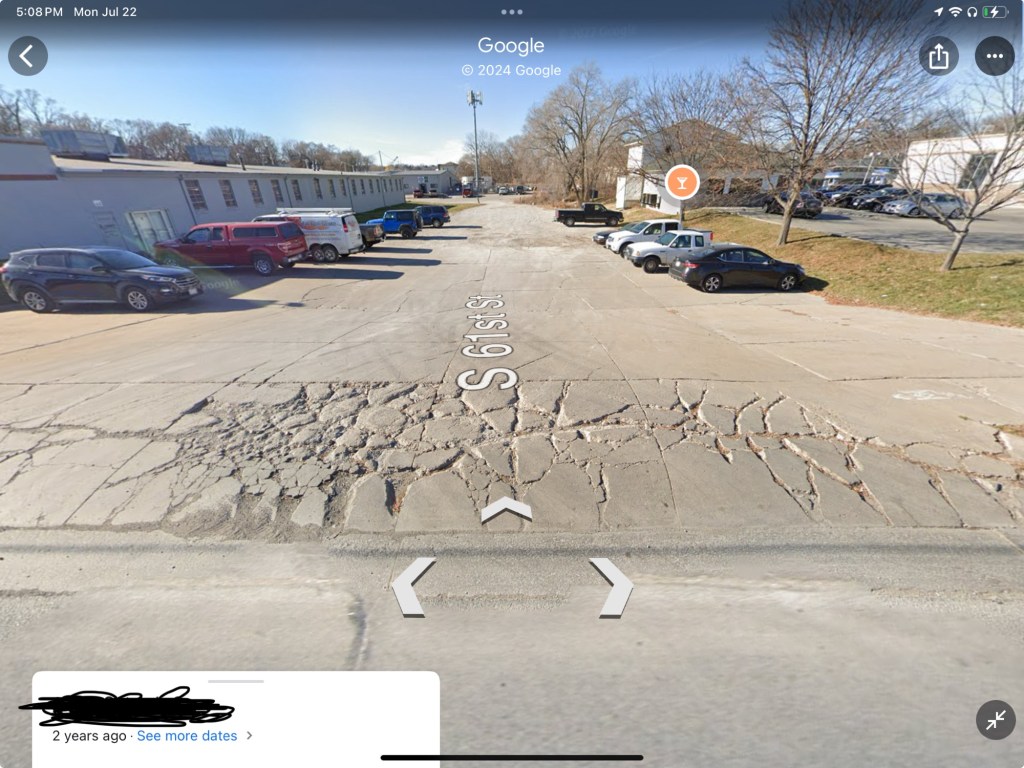
Mia and I are full-fledged bonding. It didn’t really start in force until we were alone here together. But I hardly ever use treats with her anymore and she is happy for me to praise her. Yesterday I walked on a driveway that I hadn’t walked on in months. The last time I walked on it, I sort of tripped because the concrete was very broken up. Yesterday, without me even saying anything or remembering that the driveway was crumbling, Mia walked me into the driveway and around it so I avoided the whole thing. When I realized what she was doing, I praised her lavishly and she looked at me and had a little skip in her step. It was fun, but also a sign that she is starting to understand the job, and care enough about me (or at least my praise) to think ahead and strategize this on her own. I was so happy! It is these moments that I will miss if I leave the guide dog world. My hope is that guide dog training can improve its transparency and quality, allow for real accountability from real users, and that we can all mutually respect each other enough to work toward a shared goal of good guide dog teams.
 Writebook